- Horses
- Health
- Blood Types
1. 5. 2026
Equine Blood Types
Horses, just like humans and other animal species, have blood types. Blood types are determined by antigen structures on red blood cells and are based on genetic information inherited from one’s parents. You’ve almost certainly heard about the ABO blood group system in humans, which divides our population into four groups – A, B, AB, and O. However, in some animal species, the blood group systems are not as straightforward, and horses are not an exception.
There are seven internationally recognized equine blood group systems - A, C, D, K, P, Q, and U. You may also have come across them with the prefix EA-, for example, EAA (for the blood group system A), which is a shortcut for Erythrocyte Antigen System A. Each system is further divided into multiple antigenic factors, which are usually marked with a small letter or with an index. A horse’s blood type is therefore written as a combination of a capital letter for a particular blood group and a small letter/index for a genetic factor.
Over 30 erythrocyte antigenic factors have been identified within known blood groups based on serological reactions between antigens and corresponding antibodies and hereditary patterns. However, to this day, the molecular genetic basis of equine blood group antigens has remained largely unexplored.
However, in March of this year, a new study was published, associating an equine blood group with a specific gene for the first time. Scientists linked the K blood group to the GYPA (Glycophorin A) gene. Glycophorin A is a major glycoprotein located in the membrane of red blood cells, where it contributes to the cell’s surface structure, giving it a strong negative charge.
The high variability in blood types is beneficial in some ways but less so in others. Before the introduction of genetic methods, blood types were used to determine paternity in horses. However, the variability makes it nearly impossible to find a perfect donor-recipient match for a blood transfusion. Fortunately, in most cases, antibodies against foreign red blood cells are not naturally present in the horse’s plasma and only develop after exposure to foreign antigens. Therefore, the first transfusion is typically safe.
Another important topic related to equine blood types, particularly relevant now when the breeding season is in full swing here in the Northern Hemisphere, is Neonatal Isoerythrolysis (NI). Neonatal Isoerythrolysis is a life-threatening condition of newborn foals characterised by breakdown of red blood cells, which is an immune reaction triggered by the intake of antibodies against the foal’s own blood type via the dam’s colostrum. It occurs when the foal inherits its sire’s blood type, the dam has a different one, and has been previously exposed to the antigens carried by the foal, thus carrying specific antibodies in her plasma. The most serious cases occur when the foal has the blood type Aa or Qa.
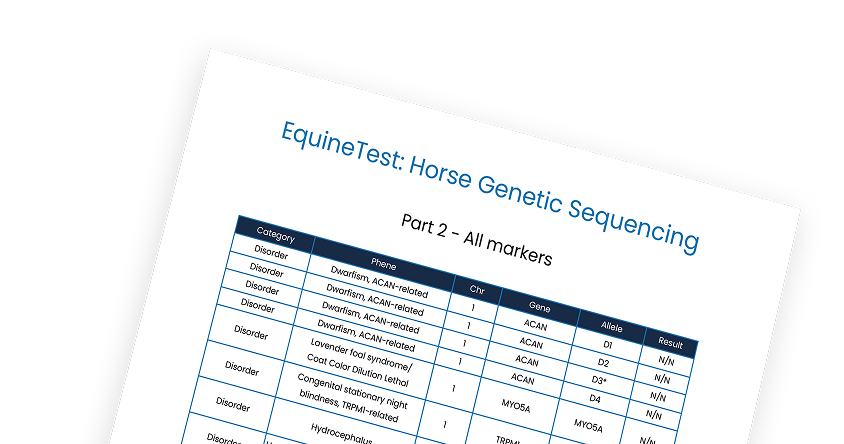
In the future, it may become possible to determine equine blood groups not only by serological methods, but also directly through genetic testing. Such an approach could identify breeding combinations that might pose a risk of the foal inheriting a high-risk blood type for NI, thereby allowing breeders to anticipate at-risk foals and ensure appropriate monitoring and management. Whole genome sequencing (WGS) may, in the future, provide a comprehensive way to screen horses for all known blood group variants. As of today, we sadly do not know enough about the genetic origin of blood groups to be able to do so. Find out more about what WGS can do today here.