
- DNA
- About us
16. 3. 2025
Why to Choose EquineTest
Traditional genetic tests give you just a glimpse, but EquineTest gives you the full story. By analysing every letter of your horse’s DNA, we unlock insights into health, traits, and genetic potential like never before — gaining more knowledge, making better decisions. Because when it comes to your horse, you deserve the whole picture.
Unlike the most common genetic tests, EquineTest is a whole genome DNA analysis. Fancy words, I know, but what does it mean?
DNA is a structure that represents the materialised genetic information of a given individual. It consists of two interconnected chains, which are made up of bases – adenine, thymine, guanine, and cytosine. Practically, in notation, these bases are represented by the initial letters of their names – A, T, G, and C. During whole genome DNA analysis, we determine the order of these bases. All of them. This leaves us with 2.7 billion letters in a particular order, which is unique for a given horse. This is what is called a genome.
The order of bases in some parts of the genome can be variable without affecting the animal in a bad way - a horse can be gray, palomino, or bay. In other parts of the genome, the order is precisely defined and practically determines the viability and health predisposition of the animal - any change, a mutation, can directly affect the health of the horse or their offspring.
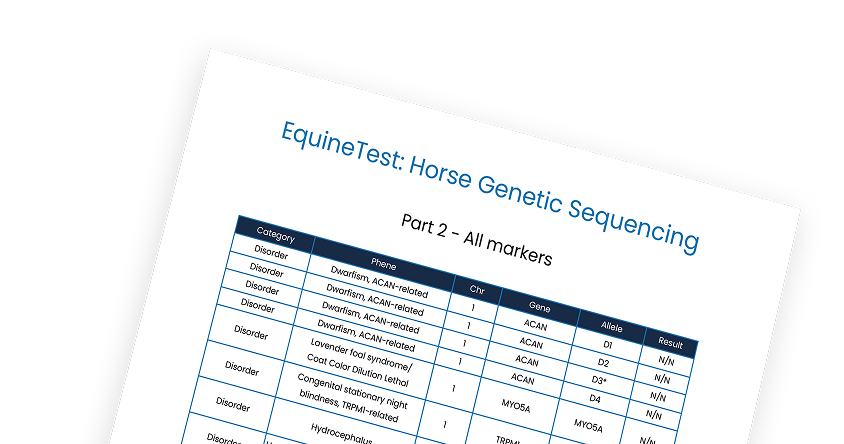
Typically, with the most common genetic testing, you target particular parts of the genome to determine the order of the bases in them. When you want to know what colours a horse can pass on to its offspring, you target a different part of the genome than when you want to know whether the long-awaited foal of the said horse can suffer from Fragile Foal Syndrome or not. You pick a page in a foreign book (choose a genetic test for Fragile Foal Syndrome, for example) and ask the biologist to translate it, to find out whether the word you are looking for is there (whether the horse’s foal may suffer from it or not).
With whole genome DNA analysis, it’s different. You don’t target a particular mutation; you read the whole genome, meaning you get the order of all the bases. So, for example, it can tell you that the horse doesn’t suffer from Polysaccharide Storage Myopathy you or your vet has assessed as the most likely, but it suffers from Myosin-Heavy Chain Myopathy, which can sometimes manifest similarly. It can tell you your horse is bay, but its foal may be chestnut. It tells you whether your horse has a clear 6 panel or not. You don’t get only one page of the book. You get the whole book and everything that can be translated in it.