
- About us
20. 7. 2024
EquineTest Comparison to Traditional Genetic Testing
Present market-dominating methods of horse DNA analysis you may be aware of typically study specific informative markers one by one. This requires a three-step procedure:
Sampling
Wet-lab processing of the sample having in mind what marker is in question
Data analysis and reporting
But what if you start thinking of another DNA marker? Your horse may and its sample will for sure undergo another round of it (sampling and/or analysis), with a new marker under focus. Of course, you can combine analysis of several markers at a time but always you need to specify them first and always there will be questions like: What another test should I consider? Why have I not included this marker too?
Therefore, as you can see yourself, although these traditional and widely used approaches offer valuable insights into specific traits, they suffer from obvious drawbacks, the inability to provide a full picture being the most important one.
EquineTest Whole Genome Sequencing advantages are, namely:
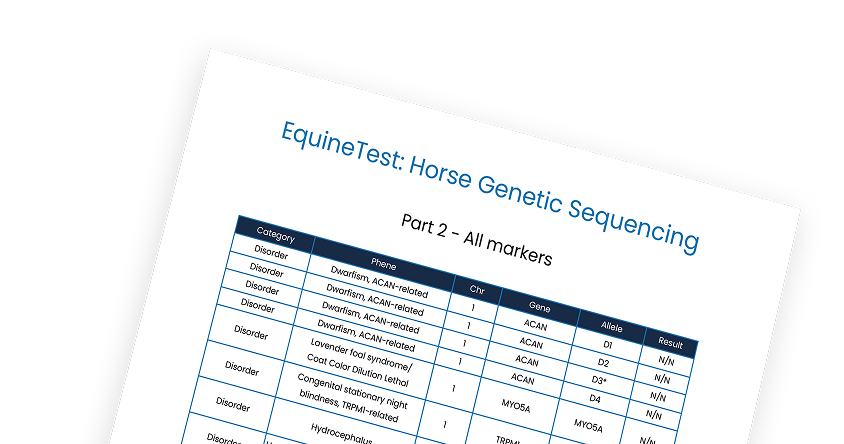
We cover the broad picture encoded in the entirety of your horse's genome and capture the full spectrum of genetic information. In fact, the broadest you can think of. With EquineTest whole genome sequencing, you gain a comprehensive understanding of your horse's genetic makeup.
EquineTest is assumption-free. Every specific genetic marker you have ever thought or heard of will be covered and you do not need to tell us upfront what you are looking for in your horse’s DNA. In fact, even markers you or scientists are not aware of yet will be covered too. It is like having the entire storybook, and not just a few words or chapters at best when using traditional methods.
We require a single sampling of your horse only. Once you send us your horse’s sample and we isolate the DNA, we will sequence it and the data can be stored forever. If you later decide for another look into your horse genomic makeup or if there are new traits discovered or associations found by scientists in the future, there is no need of additional sampling. The book of your horse’s DNA will be available at hand.
The more horse genomes are sequenced, the more data is available to compare them to each other. By analyzing tens or hundreds of genomes, people will be able to uncover previously unknown genetic predispositions for specific diseases or key performance characteristics of sport horses. If you have the whole genome of your horse analyzed, we can draw conclusions that are basically related to the individual in question. But if you have the genomes of your entire stable analyzed, we can start comparing them to each other, getting a new and higher level of information. We can create a large catalogue of known and new traits to help the community understand the horse DNA landscape. And you can be a part of it!
EquineTest team