- Horses
- Health
- Muscle Diseases
- Diagnostics
15. 1. 2026
Genetic Health Panel Tests
If you’ve ever been around Paint or Quarter Horses, you have probably heard of health panel tests, more specifically, 5-, 6-, or 7-panel tests. A genetic health panel test is an umbrella term for multiple tests targeting several diseases, with the exact number of covered diseases varying between different panels. The respective associations overseeing these breeds may require these panel tests when registering horses for breeding, especially in the case of stallions.
The 5-panel test was a starting point for the other two panels, and it covers the diseases listed below:
Hyperkalemic Periodic Paralysis (HYPP) - An autosomal co-dominant disease caused by a mutation in the SCN4A gene, which encodes a subunit of a skeletal muscle sodium channel. The mutation disrupts the body’s ion balance, resulting in hyperkalemia - excessive potassium in the blood - muscle tremors, paralysis, weakness, and in some cases, sudden death due to cardiac arrest or respiratory failure.
Hereditary Equine Regional Dermal Asthenia (HERDA) - An autosomal recessive trait caused by a mutation in the PPIB gene, affecting collagen synthesis and thus causing skin to be very fragile. Horses usually present with lesions on their backs, and because of this, they are typically unridable.
Glycogen Branching Enzyme Deficiency (GBED) - An autosomal recessive disease that is fatal at a very young age. It’s caused by a mutation in the GBE1 gene, resulting in an inability to store glycogen, which is necessary for the proper function of organs such as the heart, liver, brain, and skeletal muscles.
Malignant Hyperthermia (MH) - An autosomal dominant trait caused by a mutation in the RYR1 gene, causing a hyperthermic state when triggered by excitement, stress, or application of anesthetics. Symptoms include increased temperature, heart rate, blood pressure, and sweating. Without immediate medical intervention, this state can be fatal.
Polysaccharide Storage Myopathy Type 1 (PSSM1) - An autosomal dominant disease caused by a mutation in the GYS1 gene, resulting in an abnormal glycogen accumulation in muscles. This can lead to symptoms such as muscle pain, tremors, reluctance to move, and dark urine.
The 6-panel is where it differs between Quarter and Paint Horses. The basis is the same; the panels for both breeds contain all tests from the 5-panel and one additional test, thus turning the 5-panel into a 6-panel. AQHA (American Quarter Horse Association) added a sixth test for Myosin-Heavy Chain Myopathy (MYHM) for Quarter Horses in the 2023 breeding season. On the other hand, the genetic health panel for Paint Horses includes a test for Overo Lethal White Syndrome (OLWS) instead of the one for MYHM.
Myosin-Heavy Chain Myopathy (MYHM) - Muscle disease caused by a mutation in the MYH1 gene, which can result in two different presentations: immune-mediated myositis (IMM), which is triggered by environmental factors such as infection or vaccination, and non-exertional rhabdomyolysis. Both can result in muscle atrophy and generalized weakness.
Overo Lethal White Syndrome (OLWS) - Also known as Lethal White Overo (LWO), OLWS is associated with the overo spotting pattern, which results from a heterozygous mutation in the EDNRB gene. This state doesn’t seem to affect the general health of the horses, unlike the homozygous variant, which is typically incompatible with life.
And finally, the 7-panel is a combination of 6-panels for both breeds. In other words, it includes tests for HYPP, HERDA, GBED, MH, PSSM1, MYHM, and OLWS.
Panel tests are typically required by Paint and Quarter Horse associations when registering stallions for breeding, as there is a possibility of a high number of offspring and, therefore, a possibility of a high number of offspring potentially affected by a genetic disease. Breed associations only recognize results from specific laboratories for horse registration. However, causal mutations are publicly known and can be tested elsewhere. It is important to note that the genetic health of the sire is only half of the genetic health of the offspring, and it should be in the breeder's interest to also know the genetic profile of the dam.
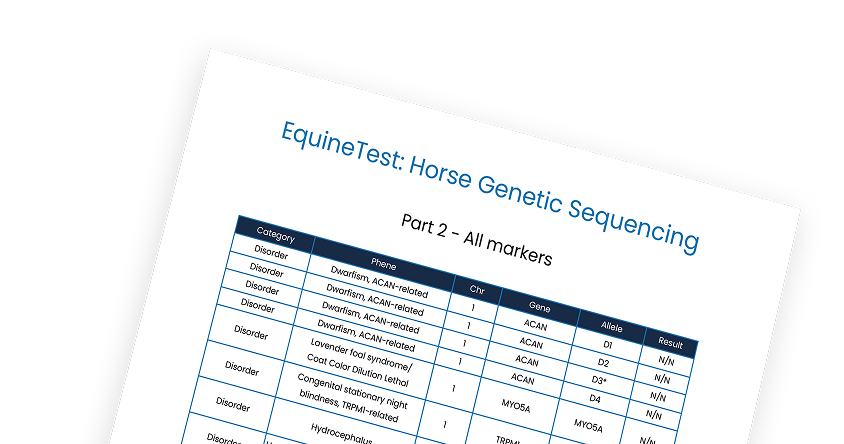
While panel DNA tests are a well-established standard in horse breeding, whole genome sequencing (WGS) represents a fundamentally different level of genetic insight. Instead of testing only a predefined set of markers, WGS analyzes the horse’s entire DNA—covering all known disease-associated variants, all markers currently included in genetic panels, and variants that have not yet been described.
What does this mean in practice? With whole genome sequencing, no additional genetic testing is needed—now or in the future. As science advances and new disease markers are discovered, your horse’s existing genome data can be re-analyzed without retesting or resampling. In other words, WGS is future-proof.
For breeders focused on long-term health, informed mating decisions, and maximum transparency, whole genome sequencing offers:
the most comprehensive genetic health profile available
protection against unexpected future panel expansions
a single, permanent investment instead of repeated testing
a decisive advantage in responsible breeding strategies
Whole genome sequencing moves genetic testing from a checklist approach to a strategic asset—one that grows in value as genetic knowledge evolves. You can order whole genome sequencing from EquineTest here.