- Health
- Diagnostics
21. 8. 2025
When the Test Results are Negative but the Symptoms are Present
It may have happened to you, your friend, a family member, your dog or your horse. A genetic test was run in the hope of finding a reason behind your or their health problems, but the test results were negative. No questions were answered, and the patient was left undiagnosed. For now.
The thing with genetic testing is that it’s still rapidly developing. What we know and understand so far is only a fraction of the information available, and science continues to make new discoveries. Just because we don't know the answers now doesn't mean we won't know them in a few years, as progress is made in this field every year.
As an example, we can name Equine Juvenile Spinocerebellar Ataxia (EJSCA). It’s a neurological genetic disease affecting American Quarter Horse foals that was identified just this year. However, the case that sparked the attention actually happened five years earlier. In the spring of 2020, in Oregon, an American Quarter Horse foal that appeared healthy and bright at birth developed severe neurological symptoms (ataxia, inability to stand) in its first month of life, and all known tests for neurologic diseases came back negative. At the end, a total of 12 cases of foals with similar symptoms were described, and moreover, the foals were found to be related. Five years forward, the mutation responsible for the disease is known, although yet to be published. Once this causal mutation becomes publicly available, it will enable the development of targeted genetic testing, allowing future cases of the disorder to be detected early and providing breeders with a tool to make informed mating decisions to prevent its occurrence.
A correct diagnosis of a previously unresolved health condition depends not only on the identification of a causal mutation but also on several additional factors. These may include the emergence of new or previously unrecognized clinical symptoms, which can provide essential context for variant interpretation and help complete the diagnostic picture. Equally important are ongoing technological advances, such as improvements in sequencing hardware, the development of new analytical algorithms, progress in artificial intelligence, and continuous updates of variant and reference databases. Together, these factors enhance our ability to interpret genetic variation accurately, and any one of them may be critical to achieving a successful diagnosis.
If the disease is genetic, it’s hidden somewhere in the genome. We just may not be able to decode it yet. However, reanalysing genetic data increases the chances of successful diagnosis by tens of percent, as multiple studies (1, 2) show in human genetics.
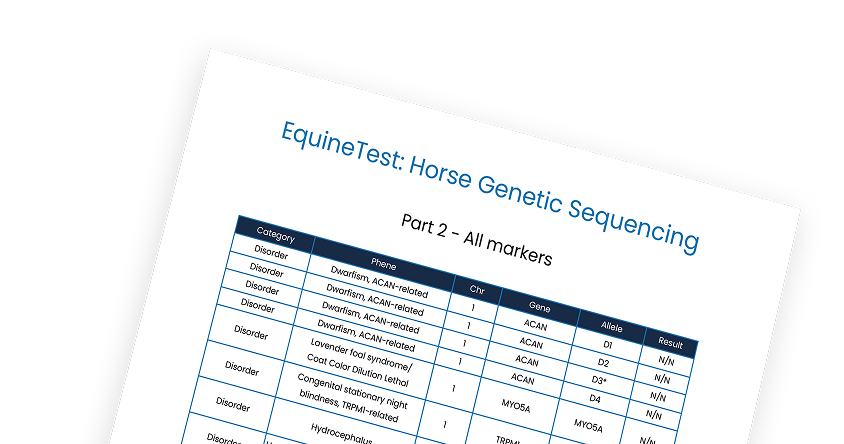
In EquineTest, we offer data reanalysis once a year to keep up with newly discovered genetic markers. You do not need to perform additional tests or take new samples, as with whole genome sequencing, your horse’s genetic information remains a lifelong source - continuously revealing new information as science advances.