- Horses
- Health
15. 4. 2025
Fragile Foal Syndrome – Not Only a Warmblood Problem
With breeding season in full swing here in the Northern Hemisphere, some genetic diseases are being mentioned more frequently than others. Fragile Foal Syndrome (FFS), also known as Warmblood Fragile Foal Syndrome (WFFS), is one of them. It is a disease most often associated with dressage warmbloods, but it can also be found in show jumpers, eventers, and — although much less frequently — in Paint Horses, Thoroughbreds, and other breeds.
Fragile Foal Syndrome has only received attention in the last decade or so, although it has existed in the horse population for much longer. It is caused by a mutation in the PLOD1 gene, which encodes an enzyme essential for collagen fibril formation. Collagen is a protein found in many tissues, such as ligaments, tendons, cartilage and skin, and the state of these tissues is inevitably affected by the incorrect structure of the protein.
There may be multiple reasons why the Fragile Foal Syndrome was undetected for so long. First of all, it’s an autosomal recessive disease, meaning that a foal must inherit the mutation from both parents to be affected. Secondly, most of the affected embryos and fetuses are aborted during gestation, and a live foal is born only rarely. Affected foals mainly suffer from hypermobile joints, which result in an inability to stand, and extremely fragile skin, prone to tearing. The condition is incompatible with life, and sadly, the foals typically must be euthanised shortly after birth.
Although only homozygous horses (i.e., those that inherit the mutation from both parents) are fully affected, recent studies have shown that carriers (heterozygotes) may also be affected, but to a much lesser extent. These findings offer an explanation why this disease seems to be connected mainly with dressage horses, as the carriers tend to perform better in traits associated with dressage than their peers who do not carry the FFS mutation at all. It has also been found that they generally have longer limbs, neck and frame.
Being a carrier does not necessarily mean the horse should be excluded from breeding. However, because of the nature of the disease, when selecting a suitable stallion or mare, the horse’s partner should be tested negative for FFS to avoid producing affected offspring.
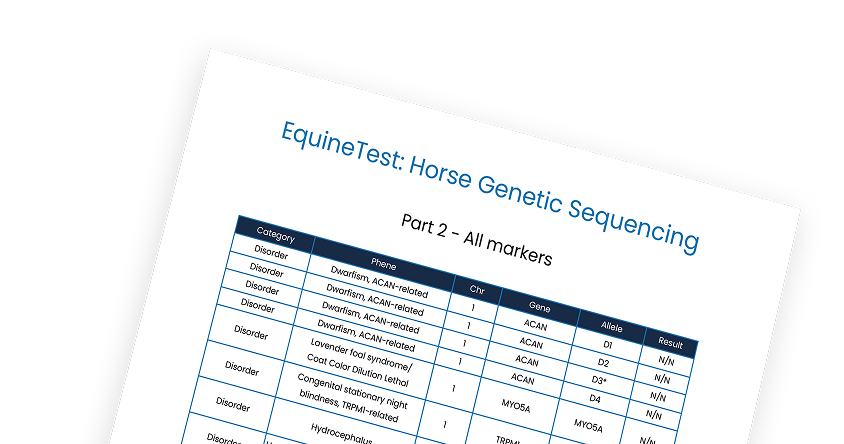
This scenario beautifully illustrates how EquineTest empowers responsible horse owners by proactively managing genetic health issues across their stables. Conducting a one-time comprehensive survey across a herd can swiftly identify animals carrying specific genetic mutations. Armed with this knowledge, owners can make informed and thoughtful breeding decisions, enhancing the overall health and future potential of their herd.
While targeted testing for individual syndromes is indeed possible, it becomes cumbersome and costly as more syndromes emerge. Instead of repeatedly addressing each syndrome individually, EquineTest provides a streamlined, comprehensive solution. By assessing multiple genetic markers in one go, EquineTest saves valuable time, effort, and resources, clearly demonstrating its long-term value in safeguarding equine health and optimizing herd management.